3-month program

Online self-paced

1 Capstone project

15+ industry projects

2 months industry training

Through Terno AI

350+ Hiring partners

50% Average salary hike

Eligibilty

No coding required

E&ICT, IIT Roorkee

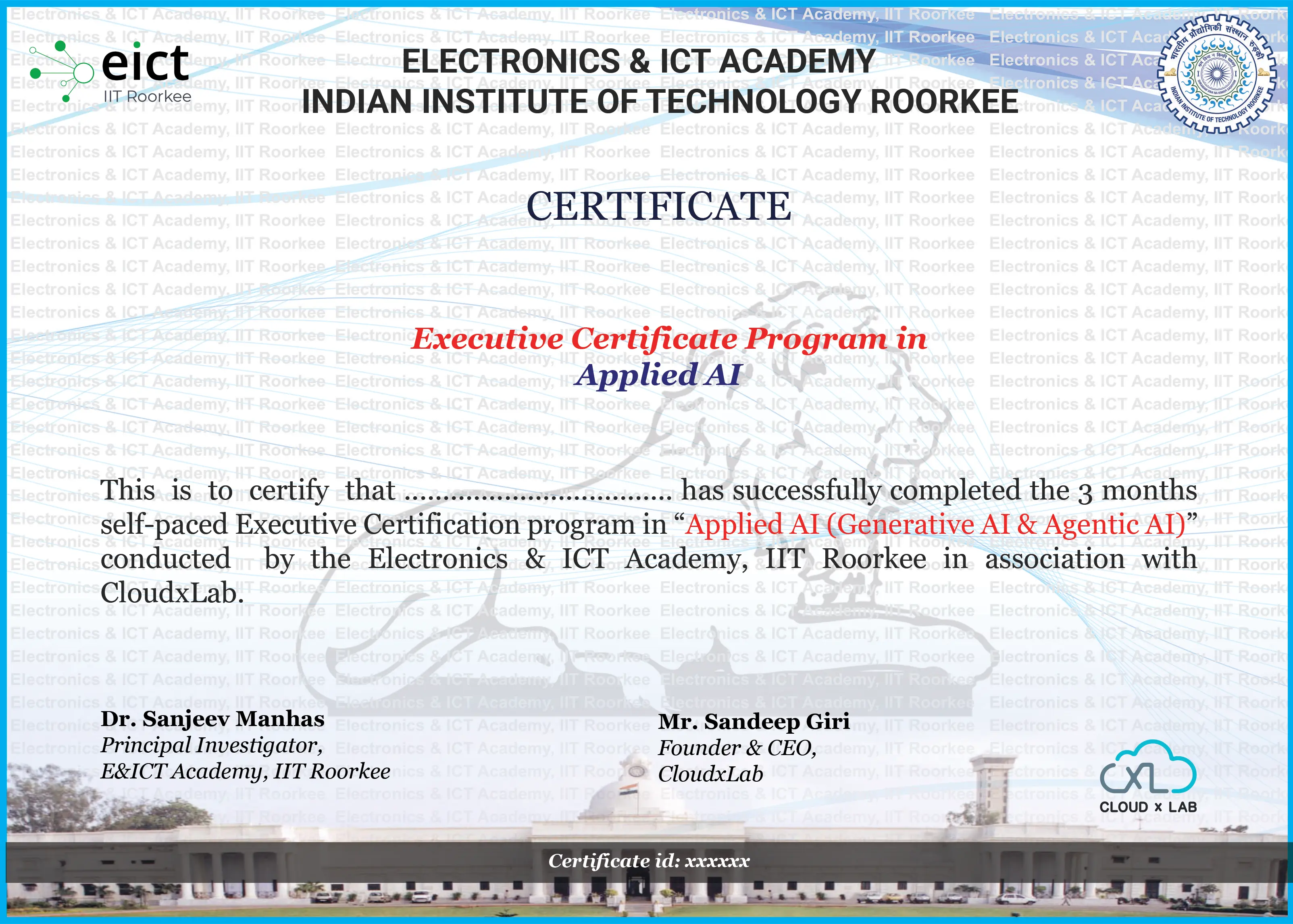
Certificate

Course Overview

Home All Courses Executive Certificate Program in Applied AI by IIT Roorkee

Executive Certificate Program in Applied AI by IIT Roorkee

The Executive Certificate Program in Applied AI by E&ICT IIT Roorkee is designed for professionals who want real AI capability, not just tool familiarity. Over three months of structured learning and two months of industry training, you’ll understand AI in simple language, learn how to use it for real work, and apply proven workflows across your domain.

The program blends clarity, hands-on practice, and expert guidance, helping you move from curiosity to confidence. Whether you work in HR, operations, finance, marketing, supply chain, or management, this program strengthens your profile for a future where AI fluency is essential. Upon successful completion, you will receive an Executive Certificate issued by E&ICT IIT Roorkee, enhancing your professional profile and opening doors to exciting career opportunities in AI, data science, and automation, no prior technical background required.

(4.82K) 37K+ Learners
15 Projects 120 Days Cloud Lab Access
Estimated 11.5M new Data Science jobs(US)
Avg. Salary of over $84000 in Data Science roles
High demands in Tech, Finance, E-Commerce, Healthcare
Highly transferable mainstream skills

Program Highlights

3-months self-paced training
2 months guided industry tarining
15+ Industry relevant projects
1 Capstone project
100% Placement support
20+ Languages and tools covered
24*7 doubt-clearing support
No programming background required
Lifetime access to course material
120 Days of cloud lab access

Book Counseling Session

Submit

Batch 4 Starts on 26  December 2025

What is the certificate like?

About E&ICT Academy, IIT Roorkee
E&ICT-IITR provides certification courses with emphasis on hands-on learning in basic/advanced topics and emerging technologies in Electronics and ICT. It is sponsored by the Ministry of Electronics and Information Technology, Govt. of India.
About CloudxLab
CloudxLab is a team of developers, researchers, and educators who build innovative products and create enriching learning experiences for users. CloudxLab upskills engineers in deep tech to make them employable & future-ready.
  • QS

    #1st

    Among the IITs in the ‘Citations per Faculty’ parameter

    *QS World Rankings

    India Today

    #5

    Ranked Engineering College

    *India Today 2020

    NIRF

    #6

    Ranked for IITs

    *NIRF 2020

    QS

    #12

    Ranked Best Global Universities in India

    *QS World Rankings

    Hands-on Learning

    hands-on lab
    • Gamified Learning Platform
      Making learning fun and sustainable

    • Auto-assessment Tests
      Learn by writing code and executing it on lab

    • No Installation Required
      Lab comes pre-installed softwares and accessible everywhere

    • Accessibility
      Access the lab anywhere, anytime with an internet connection

    Mentors / Faculty

    Instructor Sanjeev Manhas

    Sanjeev Manhas

    Faculty ECE Dept

    IIT Roorkee

    Instructor Sandeep Giri

    Sandeep Giri

    Founder at CloudxLab

    Past: Amazon, InMobi, D.E.Shaw

    Instructor Abhinav Singh

    Abhinav Singh

    Co-Founder at CloudxLab

    Past: Byjus

    Dr. M.L. Virdi

    Dr. M.L. Virdi

    Senior Research Scientist

    NASA

    Instructor Praveen

    Praveen Pavithran

    Co-Founder at Yatis

    Past: YourCabs, Cypress Semiconductor

    Instructor Jatin Shah

    Jatin Shah

    Ex-LinkedIn, Yahoo, Yale CS Ph.D.

    IIT-B

    Instructor Shubh Tripathi

    Shubh Tripathi

    ML Engineer at CloudxLab

    Curriculum

    1. Brief Introduction to AI, ML & Data Science
    1.1 Understanding what AI, ML, and Data Science are — how they differ and work together.
    1.2 Understanding the differences through a classic example
    1.2.1 Spam-filter evolution: shifting from human-coded rules to machine-learned detection.
    1.3 Overview of modern AI landscape
    1.3.1 ChatGPT & LLMs (Large Language Models)
    1.3.2 NLP (Natural Language Processing)
    1.3.3 Computer Vision
    1.3.4 Agentic AI
    1.3.5 RAG (Retrieval-Augmented Generation)(All with clear explanations, theory-focused)
    2. Project- Find the Celebrity who Looks like You using Computer Vision (Optional)
    3. Project - Building a RAG Chatbot from Your Website Data using OpenAI, Langchain and Vector Database (Optional)
    4. Python for Generative AI
    4.1 Core Python Concepts
    4.1.1 Variables & data types
    4.1.2 Lists, tuples, dictionaries (most common structures used by AI-generated code)
    4.1.3 If-else conditions
    4.1.4 Loops (for, while)
    4.1.5 Functions
    4.2 Working With Data in Python
    4.2.1 Reading data from files (CSV, JSON)
    4.2.2 Basic operations on data structures
    4.2.3 How Python stores tables, rows, and values
    4.2.4 Importing libraries (import pandas as pd, etc.)
    4.3 Understanding AI-Generated Code with Terno
    4.3.1 How to read AI-generated analysis snippets
    4.3.2 Identifying which parts of the code transform, clean, or analyze data
    4.3.3 Visual walkthroughs in Terno to see how Python logic works
    4.3.4 Running simple examples to build clarity and connect concepts to real data analysis
    4.4 Optional Learning Resources
    4.4.1 Access to the complete Python course for anyone who wants to go deeper
    4.4.2 The PyQuest app for extra practice through bite-sized, interactive MCQ-based exercises
    5. Data Types, Databases & SQL
    5.1 Types of Data
    5.1.1 Structured, Semi-Structured, and Unstructured (BDH – self-paced)
    5.1.2 Real-world examples for each
    5.2 Databases & SQL Basics
    5.2.1 ERP database walkthrough using Terno AI
    5.2.2 5–6 simple SQL query examples (SELECT, WHERE, GROUP BY, JOIN, etc.)
    5.3 Hands-On Data Exploration in Terno
    5.3.1 Loading and describing JSON, CSV, text files
    5.3.2 Connecting to a database inside Terno AI
    5.4 Common Beginner Blockers
    5.4.1 Frequent issues when handling data
    5.4.2 Practical solutions to overcome them
    6. Basic Analytics (AIM)
    6.1 Statistical Foundations
    6.1.1 Mean, median, mode
    6.1.2 Variance, standard deviation, IQR
    6.1.3 Normal distribution
    6.1.4 Correlation & correlation coefficient
    6.1.5 Hypothesis testing
    6.2 Data Preparation Essentials
    6.2.1 Quick handling of outliers & missing values
    6.2.2 Basic cleanup to ensure reliable analysis
    6.3 Feature Scaling Techniques
    6.3.1 Standardisation (Z-score)
    6.3.2 Min–Max scaling
    6.4 Analytical Intuition & Plot Selection
    6.4.1 Choosing the right plot based on data type and purpose
    6.4.2 Learn visuals like treemaps, Pearson correlation heatmaps, histograms, boxplots, scatter plots, etc.
    6.5 Applied Examples in Terno
    6.5.1 Running basic analytics
    6.5.2 Generating plots and insights directly within Terno
    7. Machine Learning Types (AIM)
    7.1 Supervised Learning
    7.1.1 Classification vs Regression
    7.1.2 Real-world examples: spam detection, churn prediction, price prediction
    7.1.3 How models “learn from labelled data”
    7.2 Unsupervised Learning
    7.2.1 Clustering and segmentation
    7.2.2 How AI discovers patterns without labels
    7.2.3 Examples: customer groups, anomaly detection
    7.3 Reinforcement Learning
    7.3.1 Agent–environment concept
    7.3.2 Rewards, actions, learning by trial and error
    7.3.3 Examples: robotics, game-playing AI
    7.4 How to Interpret AI-Generated ML Results
    7.4.1 Understanding accuracy, precision, recall, F1-score
    7.4.2 Interpreting confusion matrices
    7.4.3 Reading AI explanations of model decisions
    7.4.4 Identifying when a model is underfitting or overfitting
    7.5 Conceptual Exercises
    7.5.1 Small scenario-based questions
    7.5.2 Identifying which ML type fits a given problem
    7.5.3 Interpreting output summaries (no coding)
    8. Machine Learning Process (AIM)
    8.1 End-to-End ML Workflow
    8.1.1 Problem definition
    8.1.2 Data collection & understanding
    8.1.3 Data cleaning and preparation
    8.1.4 Feature selection & feature importance
    8.1.5 Model training concept (no coding)
    8.1.6 Model evaluation and comparison
    8.2 Understanding ML Outputs
    8.2.1 Interpreting metrics for classification & regression
    8.2.2 Reading AI-generated plots
    8.2.2.1 ROC curve
    8.2.2.2 Feature importance charts
    8.2.2.3 Residual plots
    8.2.3 Identifying bias, errors, and model limitations
    8.3 Concept of Model Deployment
    8.3.1 What happens after a model is built
    8.3.2 How predictions are served in real apps
    8.3.3 Why deployment matters for business outcomes
    8.4 ML Process Example in Terno AI
    8.4.1 Step-by-step conceptual walkthrough of ML in Terno
    8.4.2 Understanding generated insights, metrics, and charts
    9. ML Projects using Generative AI
    9.1 Sentiment Analysis
    9.1.1 Sentiment Analysis in Hive Using Terno AI
    9.1.2 Building a Sentiment Classifier using Python and IMDB Reviews with Terno-AI
    9.2 Customer Segmentation (Unsupervised Learning)
    9.2.1 Customer Clustering for E-commerce Behaviour
    9.2.2 User Segmentation for Targeted Marketing Campaigns
    9.3 Sales & Demand Forecasting (Time Series)
    9.3.1 Monthly Sales Forecasting Using Terno AI
    9.3.2 Demand Prediction for Inventory Planning
    9.4 Churn Prediction (Classification)
    9.4.1 Subscriber Churn Prediction Dashboard
    9.4.2 Customer Retention Analysis with Feature Insights
    10. AI Constructs (AIM) (Optional)
    10.1 Core AI Constructs
    10.2 Applied Examples
    11. Generative & Agentic AI
    11.1 ChatGPT & LLM Fundamentals (Optional)
    11.2 Prompt Engineering Essentials
    11.2.1 Writing effective prompts
    11.2.2 Using chain-of-thought for better reasoning
    11.3 Working with APIs & Function Calling
    11.3.1 How AI tools call functions behind the scenes
    11.3.2 Conceptual examples of API requests handled by AI
    11.3.3 When and why function calling is used in data analysis
    11.4 How Terno Works (Inside the Tool)
    11.4.1 Workflow of Terno
    11.4.2 How Terno interprets queries, runs analysis, and returns results
    11.4.3 Understanding Terno’s strengths, limitations, and best practices
    12. Workflow Automation
    12.1 Introduction to Automation Tools
    12.1.1 What workflow automation means
    12.1.2 Where automation fits in data and AI processes
    12.2 N8N Automation Examples
    12.2.1 How to automate repetitive data tasks
    12.2.2 Connecting apps, triggers, and actions visually
    12.2.3 Real examples of building simple automated workflows with N8N
    13. Build Your Own GPT (No-Code)

    3
    Months Self-paced Training
    90
    Days of Lab Access
    15+
    Projects
    14.2K+
    Learners

    Skills Covered

    20+ skills covered under this course

    Python Programming
    Data Science
    Data Analysis
    Data Visualization
    Mathematical Modelling
    Machine Learning
    Supervised Learning
    Deep Learning
    Reinforcement Learning
    Generative AI
    Artificial Intelligence
    Model Training and Optimization
    Machine Learning Algorithms
    Model Evaluation and Validation
    Large Language Models
    Conversational AI
    Natural Language Processing
    Speech Recognition
    Computer Vision
    Prompt Engineering
    ChatGPT
    Story Telling
    Research Methods

    Projects

    Enroll Now

    Batch 2: Oct 2025

    Sold Out!

    499 999

    • 3 Months Program
    • Online Self-paced Training
    • No pre-requisite
    • 90 Days of Online Lab Access
    • Cohort Starting 30 Oct
    • 24*7 Support
    • Certificate from E&ICT, IIT Roorkee
    Enrollment Closed »

    Batch 3: Nov 2025

    Filling Fast

    499 999

    • 3 Months Program
    • Online Self-paced Training
    • No pre-requisite
    • 90 Days of Online Lab Access
    • Cohort Starting 30 Nov
    • 24*7 Support
    • Certificate from E&ICT, IIT Roorkee
    Enrollment Closed »

    Batch 4: Dec 2025

    Early Bird Price

    449 799

    • 3 Months Program
    • Online Self-Paced Training
    • No Pre-requisite
    • 90 Days of Online Lab Access
    • Cohort Starting 26 Dec 2025
    • 24*7 Support
    • Certificate from E&ICT, IIT Roorkee
    Enroll Now »

    Placement Assistance

    By CloudxLab

    Placement Eligibility Test

    Placement Eligibility Test

    We have around 350+ recruitment partners who will be interviewing you based on your performances in PET

    Dedicated Job Portal

    Dedicated Job Portal

    Opportunities from companies who approach us asking for our learner profiles will be posted on our job portal to providevisibility to your profile

    Career Guidance Webinars

    Career Guidance Webinars

    Career Guidance Webinars from seasoned industry experts

    Testimonials

    Related Courses

    Post Graduate Certificate Program in Data Science & AI (Including Agentic AI) by IIT Roorkee

    Post Graduate Certificate Program in Data Science & AI (Including Agentic AI) by IIT Roorkee

    Hands-on Generative AI with Langchain and Python

    Hands-on Generative AI with Langchain and Python

    Frequently Asked Questions

    Will I get support?

    Yes! Please feel free to ask your questions on CloudxLab forum and our community and team of experts will answer your questions. We believe forum will add better perspectives, ideas, and solutions to your questions.

    Is there any prerequisites for this course?

    No, this course is for everyone. The complimentary access to CloudxLab courses will help you in learning the required foundations to make the most out of this certificate course.

    Can I expect any placement support?

    Yes, we do offer placement assistance that includes career guidance, resume building tips and mock interviews. Each participant will receive staunch support from the industry mentors, who also direct you through various placement opportunities within the industry. Above all, we are partnered with leading MNC’s that offer placement opportunities to our participants.

    How long I will be able to access the course?

    The course access will be for 4 months. To earn the certificate, you are required to complete the course within the deadlines.

    If you are unable to complete the course within the stipulated deadlines then you can enroll in the course again to earn the certificate.

    What is the validity of the course material?

    We understand that you might need course material for a longer duration to make most out of your subscription. You will get lifetime access to the course material so that you can refer to the course material anytime.

    Do I need to install any software before starting this course?

    In this course, we will go through the installation process on a local machine and you will also be provided access to Intel® DevCloud for the Edge to learn and build AI applications remotely using a web browser. You will find instructions to get your 90 days access (which you can extend further by following the process as described in the course videos) to Intel® DevCloud for the Edge.

    For the complimentary courses by CloudxLab, we will provide you with 180 days of access to CloudxLab's online lab so that you do not have to install anything on your local machine.

    What is the refund policy?

    We provide a full refund within the initial 2 live sessions of the program. After this period, no refund requests can be accommodated.

    Will the Certificate contain the IIT Roorkee Logo?

    Yes, the PG Certificate course contains IIT Roorkee Logo, you can see the sample certificate here: https://cxl-web-prod-uploads.s3.amazonaws.com/public/filestore-uploads/2ec3a1a0f7f350b2be5eeac9e56455d87a54ffbf.webp