
Crypto knowledge is all over the place, making it tough for newcomers to find good info without BS-detection skills they just don't have yet.
Each learning source has its thing - Twitter for hot takes, Discord for chatting with communities, docs for the nitty-gritty - but none gives you the full picture. The tech stuff is buried in GitHub repos that you need coding skills to get through, while dumbed-down explanations skip the risks that could cost you money.
Many folks think they can learn crypto "just by doing" - big mistake. Sure, hands-on experience helps, but learning exclusively through crypto trial and error can wreck your finances.
What works better is a step-by-step learning approach that builds your knowledge first, then lets you practice without risking much before you put real money in play. In this article, I'll walk you through how Coinminutes tackles this problem with our approach based on four key ideas, custom learning tracks, practical methods, and group learning.

The core pillars behind clearer crypto education
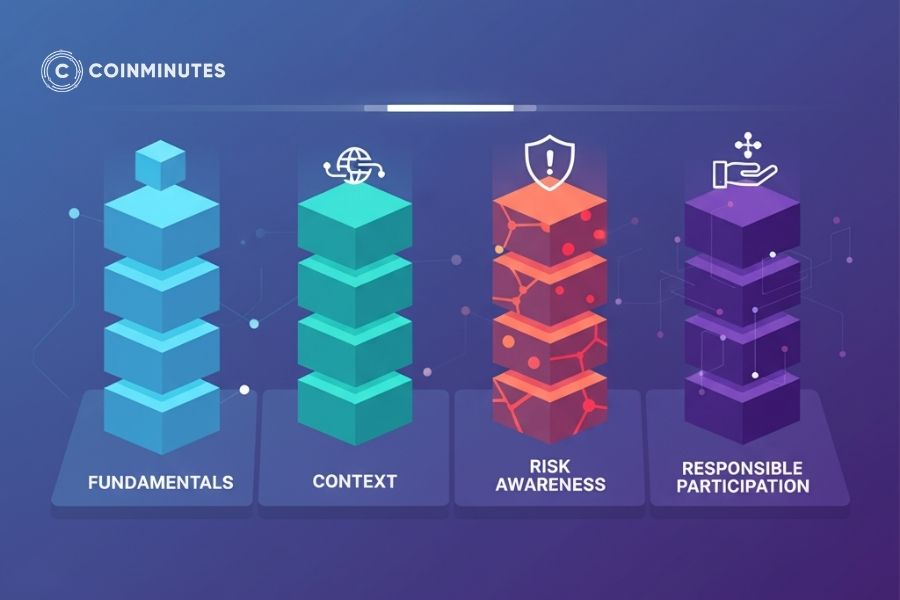
Everything we teach rests on four ideas we've hammered out over time. Together, they don't just dump technical facts in your lap - they help you actually get crypto in a way that saves you from costly mistakes.
Our first pillar? Get the basics down cold before anything else. Look, you can't build on shaky ground. We ditched the usual tech babble and instead show you how blockchain works with actual visuals. Once you see nodes validating transactions with your own eyes - not just read about it - you'll catch the BS when some new protocol claims it can magically be secure, decentralized, AND fast all at once. Trust me, that matters.
The second thing we focus on is putting crypto in context. What problems did Bitcoin actually solve? How does DeFi compare to traditional banking? That bigger picture stuff.
Risk awareness comes third, and honestly, this one's personal. Back in 2014, I watched 0.7 BTC vanish in the Mt. Gox disaster because I had zero clue what counterparty risk meant. Damn expensive lesson. So now we walk through actual scenarios - not theoretical crap. Like, "Here's exactly what happens if an exchange holds your keys" or "Here's what those yield farming risks actually look like." The marketing folks conveniently skip those parts. I'd say this third piece matters most when you're starting out.
Fourth, we push for responsible participation. Markets work better when people actually understand what they're doing. Your choices affect more than your wallet - they shape this whole ecosystem.
When this stuff clicks, you stop reacting to every price swing or jumping on whatever's shilled on Twitter. You develop actual judgment. That's what we're building toward. But ideas mean nothing without execution, so let me show you how this plays out in reality.
Not everyone learning about the cryptocurrency market is starting from the same place or needs the same teaching style. Coinminutes builds learning tracks that fit where you are now, putting our core ideas into practice.

Customized routes for every crypto journey
For total beginners, we've created a path that doesn't overwhelm you with complexity right away (which is why so many people give up). It kicks off with our "Crypto Foundations" series. No technical mumbo-jumbo at first - just real-world comparisons that click. Blockchain becomes "a shared record book that everyone can check but nobody can tamper with unless most people agree." We build from there.
The key insight? We purposely save the investment stuff until after you get how the technology works. Why? Because jumping straight to "how to make money" without understanding the systems is exactly how people get rekt.
Folks with some basic knowledge often have a different problem - they know bits and pieces but can't see how it all fits together. Our approach helps you organize what you already know and spot the gaps through mapping exercises that show connections between ideas, comparisons of different technologies and their trade-offs, real case studies, and decision frameworks.
For experienced investors, we focus on deeper analysis and finding blind spots. Even veterans miss things in this fast-moving space. We include fresh looks at emerging trends and challenge assumptions that might be outdated.
Finance pros get our "translation guide," which connects familiar concepts with their crypto versions. When you see how fractional reserve banking compares to overcollateralized lending in DeFi, you can use your existing know-how while picking up crypto-specific knowledge.
Coinminutes builds on proven teaching approaches that we've refined through user feedback and watching what actually works. We don't just dump information on you - we organize it so it sticks in your brain and can be applied, then give you mental tools for using this knowledge in real life.
We focus on what teachers call "constructive learning" - connecting new ideas to stuff you already understand. This works really well for crypto, where abstract concepts make more sense when tied to systems you're already familiar with.
I'll be honest - I fought this approach at first. As a dev who came from the technical side, I wanted to dive into the code and protocols with everyone. My early workshops were packed with code snippets and technical specs that I thought were "making things simple." The blank stares from participants told me I was dead wrong.
Working with our education expert showed me that most people need real-world examples before abstract concepts make sense. Now our stuff follows a completely different pattern:

Layered learning that builds real crypto mastery
Our explainer videos break topics into chunks, adding information gradually so your brain isn't flooded. We start with the core idea, then layer in more complexity after you've got the basics down.
When we break down a case study - say an NFT marketplace - we don't just give some overall rating. We tear into the tech setup, look at who they're targeting and why, test the damn thing ourselves, and dig into security stuff separately. Then we piece it all together so you see the full picture.
For decisions, we've built these guides that actually help you apply what you've learned. Not abstract frameworks - practical stuff that accounts for your personal situation and how much risk you can stomach.
For market analysis, we try to cut through the chart-reading nonsense. Yeah, we show patterns, but we're pretty blunt about the limitations. Charts don't predict the future in crypto - or anywhere else, really.
Not gonna lie - this approach isn't perfect. The technical analysis part keeps me up at night. We hammer home that chart patterns are limited, but I've watched about 30% of our members still over-rely on them anyway. Different brains work differently, I guess. Some concepts just resist simplification - we've tried. And this space changes so damn fast that we're constantly updating everything. It's exhausting but necessary.
There's knowing crypto stuff, and then there's actually using that knowledge when your money's on the line. Big difference. We created some practical tools to help bridge that gap - because theory doesn't help much when you're staring at a promising project wondering if it's the next big thing or the next big scam:
Figure out the actual problem it solves (not just what the marketing claims)
Check technical claims with multiple independent sources
Look at the team's actual background and track record
Dig into the token economics for sustainable incentives
Check security measures and potential risks
Think about timing and current market conditions
To sharpen your BS detector, we've created what we call the FACTS framework for evaluating crypto info. (Yeah, acronyms are cheesy, but they stick in your head when you're making decisions under pressure.)
Foundation: What actual evidence backs this claim?
Authority: Who's making this claim and what's their track record?
Context: How does this fit with what's happening in the broader market?
Transparency: Are they upfront about conflicts of interest?
Significance: How should this information affect your decisions?
The framework isn't bulletproof. It struggles with truly innovative ideas where there's no history to compare against. And the "Authority" part sometimes makes people trust credentials too much in a space where breakthroughs often come from unexpected places. We're cooking up version 2.0 now, but even with its flaws, it works surprisingly well as a first check.
Our educational content is meant to inform your decisions, not make them for you. What we teach should help you spot both the landmines and opportunities, but look - your situation is your situation. Someone with a mortgage and kids has different risk calculations than a college student with disposable income. You gotta apply this stuff to your own reality.
This whole approach changes your relationship with crypto info. Instead of just consuming whatever crosses your feed, you start filtering, questioning, connecting dots. Most crypto "educators" won't admit this, but memorizing a bunch of protocol specs or tokenomics formulas isn't what makes you good at this. It's developing that nose for BS and that eye for actual value. It's building the instincts to evaluate whatever new thing pops up in this insanely fast-moving space. That judgment? Way more valuable than any facts we could teach you.
You'll learn faster with others than by yourself. Coinminutes builds community spaces that accelerate understanding through shared experiences and diverse viewpoints, putting our frameworks into practice through group brainpower.
To get the most from the Coinminutes community:
Jump into the knowledge channel that matches where you're at
Ask questions and share insights about stuff you know
Get involved in at least one discussion group regularly
Share what worked (and what didn't) to help others bridge the gap between theory and reality
Many crypto learners tell us they feel like they're learning in isolation, never sure if they're focusing on the right things or understanding them correctly. Learning together solves this problem while tapping into the group's combined knowledge to strengthen your own understanding.
Instructor:
