
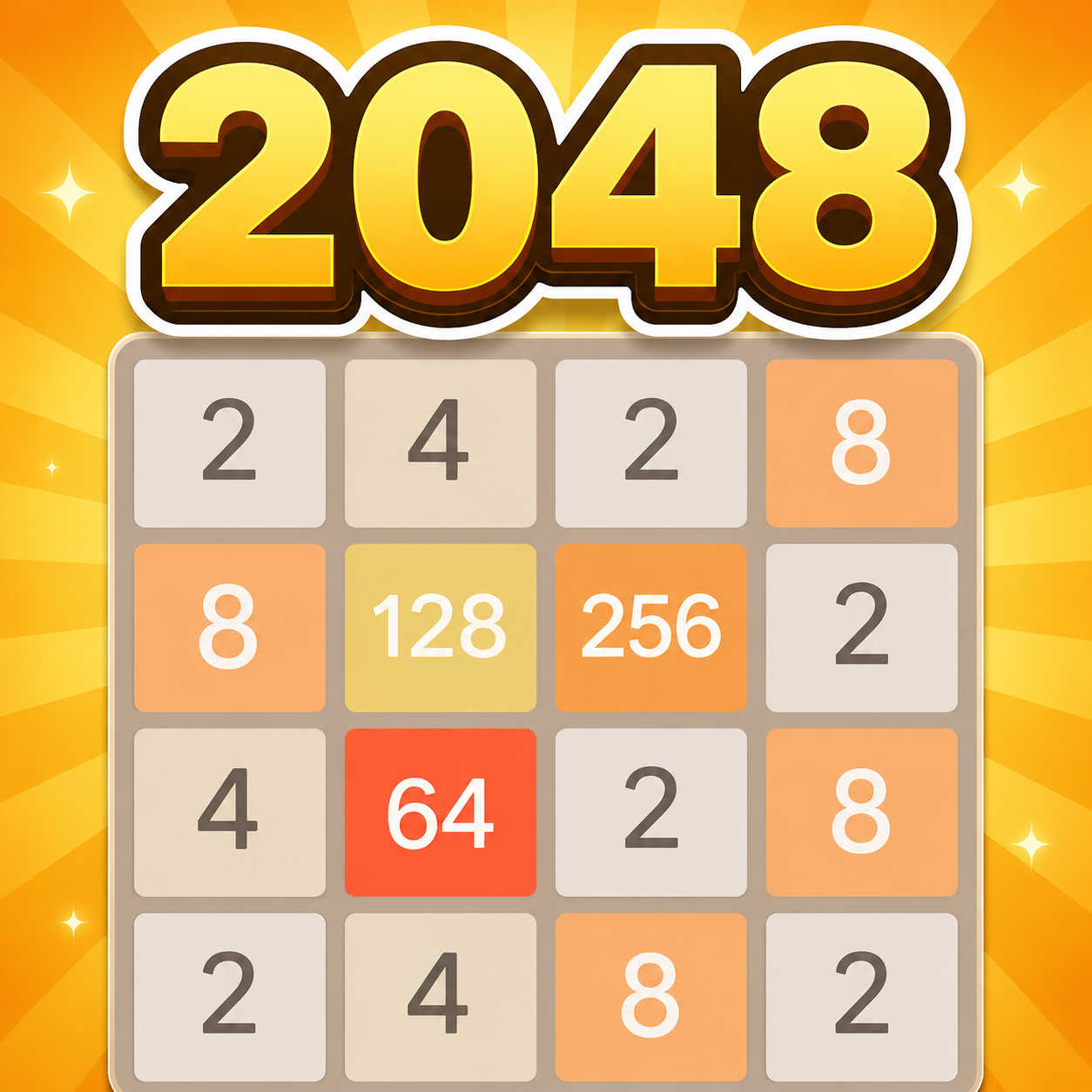
The 2048 game is a simple yet highly engaging puzzle game that has become popular among people of different ages around the world. At first glance, the game appears very easy because it consists only of a small grid and numbered tiles. However, as a player continues to play, the game becomes increasingly challenging and requires careful thinking, planning, patience, and logical decision-making. The objective of the game is to combine numbered tiles until a tile with the number 2048 is created. Although the rules are simple, achieving this goal can be surprisingly difficult.
2048 was created in 2014 by Italian web developer Gabriele Cirulli. He developed the game as a personal project after being inspired by other tile-based puzzle games. The original game became extremely popular on the Internet because it was free, easy to understand, and playable directly in a web browser. Its simple design and addictive gameplay helped it spread rapidly through social media and word of mouth. Since then, many versions and adaptations of the game have appeared on different platforms.
The game is normally played on a four-by-four grid containing sixteen spaces. At the beginning, a few tiles containing small numbers appear on the board. The player controls the tiles by moving them up, down, left, or right. When two tiles with the same number collide while moving in the same direction, they merge into one tile whose value is the sum of the two original tiles. For example, two tiles marked 2 can combine to make a 4. Two 4 tiles can become 8, two 8 tiles can become 16, and the process continues. The ultimate objective is to create a tile marked 2048.
The basic mathematical pattern of the game is based on powers of two. The tiles usually have values such as 2, 4, 8, 16, 32, 64, 128, 256, 512, 1024, and finally 2048. Each successful combination doubles the value of a tile. This makes the game an interesting combination of mathematics and strategy. Players do not need advanced mathematical knowledge to play it, but they naturally practice addition, numerical relationships, and pattern recognition while playing.
One of the most interesting features of 2048 is that every move matters. A player cannot simply move tiles randomly and expect to succeed. Every movement changes the arrangement of the board and may create either a useful opportunity or a difficult situation. For example, combining two tiles may seem beneficial at first, but it could also remove an important empty space. If the board becomes crowded, the player may have very few possible moves left. When no legal move remains, the game ends.
This makes planning one of the most important skills in 2048. Good players usually think about the consequences of their moves before making them. They try to keep larger numbers organized and maintain enough empty spaces for new tiles. A common strategy is to keep the largest tile in one corner of the board. The player then attempts to arrange smaller tiles around it in a useful order. Although there is no single strategy that guarantees success, careful organization can greatly improve a player's chances of reaching higher numbers.
Another important aspect of 2048 is patience. Players sometimes become excited when they see an opportunity to make a large combination. However, making a quick move without considering the next few moves can cause serious problems. A successful player needs to resist unnecessary movements and wait for a suitable opportunity. This teaches an important lesson that can be applied outside games: immediate rewards are not always more valuable than long-term progress.
The game also develops problem-solving skills. Each board represents a small problem that the player must solve. The player has limited space, constantly changing numbers, and unpredictable new tiles. Therefore, the player must adapt to changing circumstances. A move that was useful a few seconds ago may become dangerous later. This encourages flexible thinking rather than dependence on one fixed solution.
Decision-making is another skill that 2048 can develop. At every stage, the player usually has several possible directions to choose from. Choosing the correct direction requires observation and prediction. Players learn to consider questions such as: Which tiles should be combined? Where should the largest tile remain? Will this move create an empty space? Could this movement prevent a future combination? Thinking about these questions helps players understand the relationship between present actions and future consequences.
The simplicity of the game's design is also one of its greatest strengths. The board contains only sixteen spaces, and the controls are extremely straightforward. There are no complicated instructions, characters, weapons, or lengthy tutorials. A new player can understand the basic rules within a few seconds. Despite this simplicity, the game has considerable depth because the challenge comes from strategic decision-making rather than complicated controls.
The visual design of 2048 also contributes to its appeal. Different numbers are represented by different tile colors, making it easy for players to recognize them quickly. The numbers become visually more distinctive as their values increase. The clean design allows players to concentrate on the puzzle rather than being distracted by unnecessary details. The game demonstrates that an entertaining digital experience does not necessarily require complex graphics.
Instructor:
