
Introduction
Let’s be honest: “data scientist” is one of those job titles that sounds glamorous but feels impossible to break into.
You see the success stories online. The job listings ask for a PhD, 5+ years of experience, and fluency in 12 programming languages. And you wonder: Is there even a path here for someone like me?
There is, and it’s more achievable than most people think.
In 2026, data science is no longer an exclusive club for research scientists from Ivy League schools. Companies across India and the world, from early-stage startups to Fortune 500 enterprises, are hiring data scientists at every level, and the skill gap between supply and demand remains stubbornly wide.
This roadmap will walk you through exactly what to learn, in what order, and how long it realistically takes, whether you’re a college student, a working professional looking to switch, or someone completely new to tech.
What Does a Data Scientist Actually Do?
Before mapping out the path, it’s worth being clear about the destination.
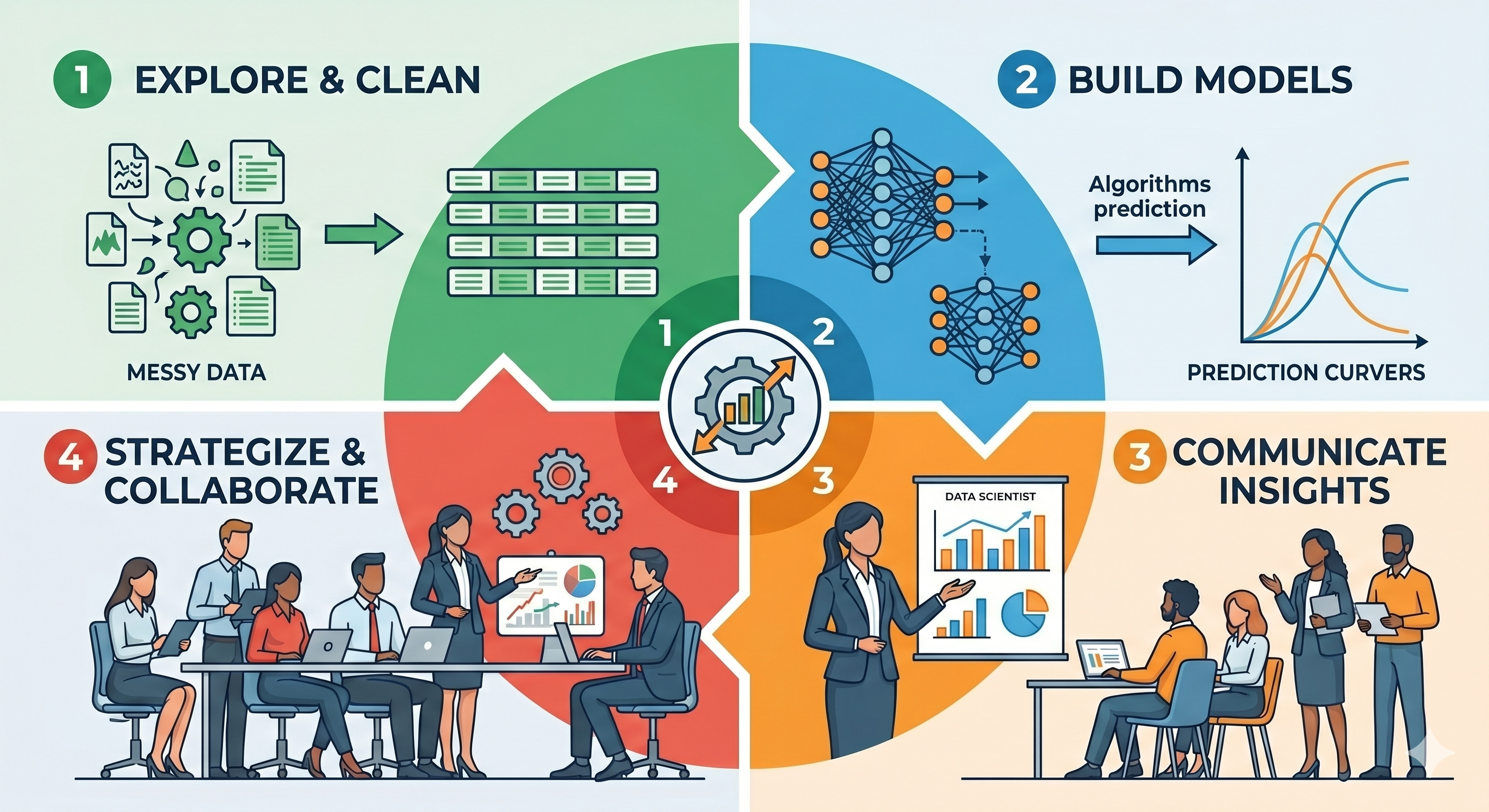
A data scientist’s core job is to extract useful insights from data and use those insights to help a business make better decisions. In practice, that means:
- Cleaning and exploring messy datasets.
- Building machine learning models to predict outcomes (customer churn, fraud, demand forecasting).
- Communicating findings to non-technical stakeholders.
- Working closely with data engineers, product managers, and business leaders.
The role varies significantly by company size and industry. At a startup, you might do everything from data collection to model deployment. At a large enterprise, you may specialize in one area. But the foundation statistics, programming, and ML intuition stay constant.
Is Data Science Still Worth Pursuing in 2026?
Short answer: yes, strongly.
India’s data science job market has continued its upward trajectory into 2026, with demand outpacing supply by a ratio of nearly 3:1 in cities like Bengaluru, Hyderabad, and Pune. Average salaries for mid-level data scientists range from ₹12-25 LPA, with senior roles and specialized AI engineers crossing ₹40 LPA at top tech firms.
Globally, the picture is equally encouraging. The U.S. Bureau of Labor Statistics projects data science roles will grow 35% through 2032, far faster than almost any other profession.
The rise of generative AI hasn’t reduced demand for data scientists; it’s reshaped what the role looks like. Companies now need people who understand AI deeply enough to evaluate model outputs, identify failure modes, and translate AI capabilities into business value, and that’s still fundamentally a data scientist’s job.
The Data Science Roadmap: Step by Step
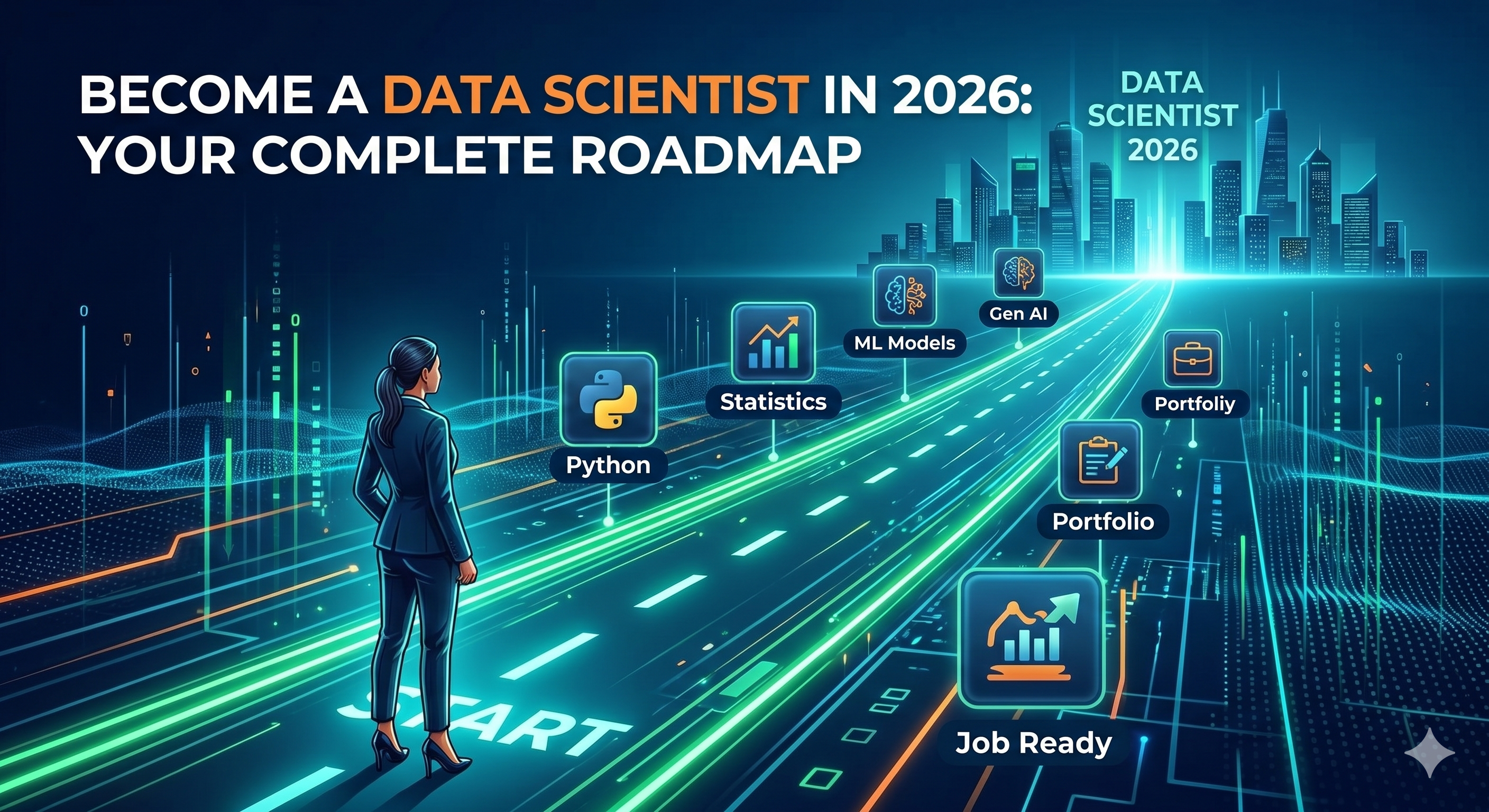
Here’s a practical, phased roadmap you can follow regardless of your current background.
Phase 1 – Build the Foundation (Months 1-3)
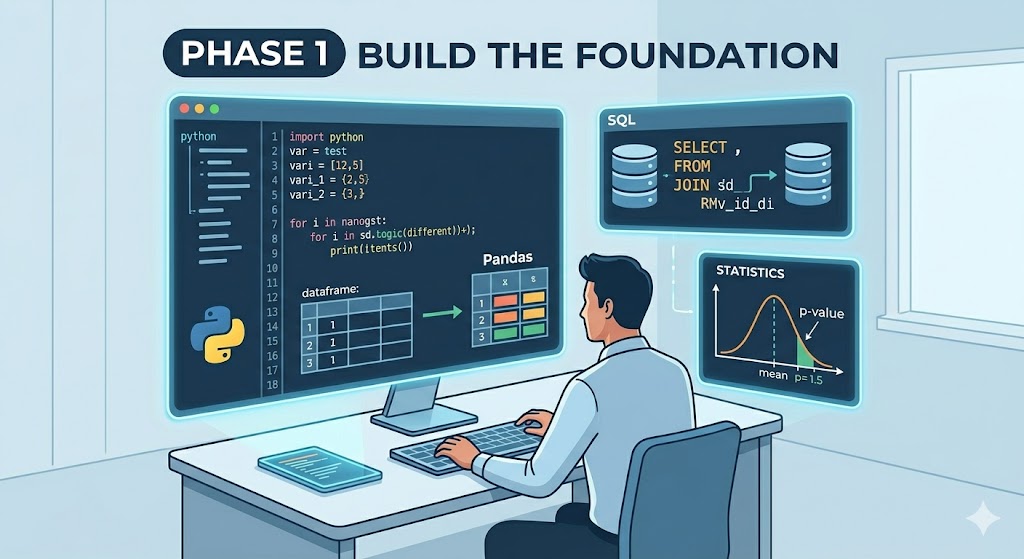
Goal: Get comfortable with programming and basic data manipulation.
You don’t need to be a computer science expert, but you do need to be able to write code that works cleanly, consistently, and without relying on someone else to debug it for you.
Python is the language to learn. It dominates data science, machine learning, and AI. Start with the basics:
- Variables, data types, loops, and functions.
- File I/O and working with APIs.
- NumPy for numerical computation.
- Pandas for data manipulation: this is where you’ll spend 60% of your time as a working data scientist.
Statistics fundamentals matter more than most bootcamps admit. You should understand:
- Mean, median, variance, standard deviation.
- Probability and distributions (normal, Poisson, binomial).
- Hypothesis testing and p-values.
- Correlation vs. causation (a critical thinking skill, not just a concept).
SQL is non-negotiable; most real-world data lives in relational databases, and being able to write clean queries, joins, and aggregations is a baseline requirement at almost every company that hires data scientists.
Recommended resources at this stage: CloudxLab’s Python fundamentals track includes hands-on lab exercises that run in a real cloud environment, with no local setup needed. You write code, get instant feedback, and build muscle memory fast.
Milestone: By the end of Phase 1, you should be able to load a dataset, clean it, run basic statistical analysis, and visualize results in Python.
Phase 2 – Learn Machine Learning (Months 3-6)
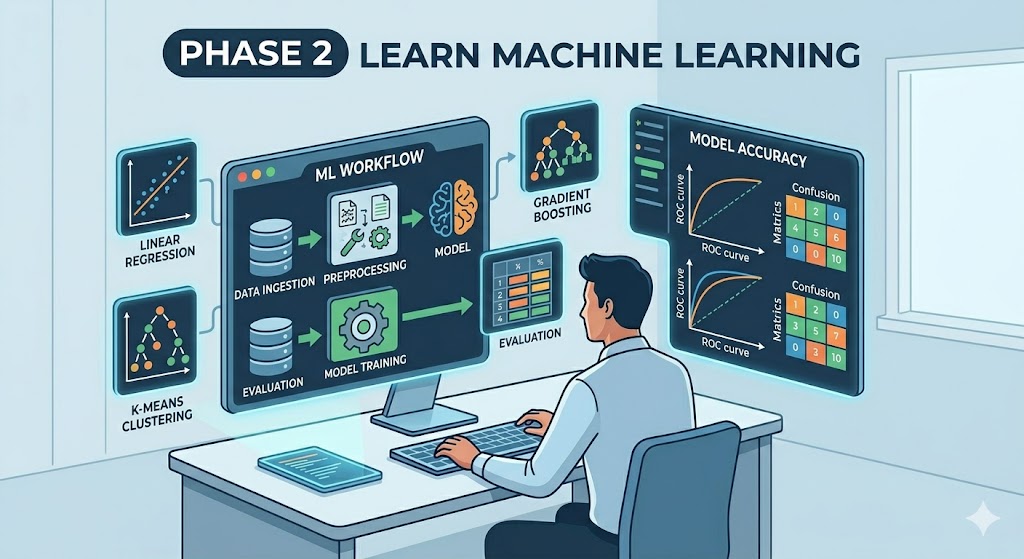
Goal: Understand how ML models work and build your first end-to-end project.
This is where data science gets exciting and where most self-learners get stuck. The key is to learn algorithms conceptually before diving into code, so you understand what you’re building and why.
Core ML algorithms to master:
- Linear and logistic regression.
- Decision trees and random forests.
- Gradient boosting (XGBoost, LightGBM).
- K-means clustering.
- Principal component analysis (PCA).
- Support vector machines.
The ML workflow: Most of your time in practice isn’t spent training models; it’s spent on everything around them. Learn this full pipeline:
- Problem framing (what are you predicting, and why does it matter?).
- Data collection and cleaning.
- Exploratory data analysis (EDA).
- Feature engineering.
- Model selection, training, and evaluation.
- Interpretation and communication of results.
Tools: Scikit-learn is your primary library for classical ML, with Matplotlib and Seaborn for visualization and Jupyter Notebooks as your day-to-day working environment.
Build projects. This is the single most important thing you can do in Phase 2. Don’t just follow tutorials; build something yourself. Good starter projects:
- A house price prediction model.
- A customer churn classifier for a telecom company.
- A spam vs. not-spam email classifier.
CloudxLab’s guided project library has over 40 projects across these domains, all running in a live cloud lab with real datasets. You don’t just read how it’s done; you actually do it.
Milestone: By the end of Phase 2, you should have 2-3 working ML projects you can talk about in an interview.
Phase 3 – Go Deep: AI, Deep Learning & Specialization (Months 6-9)
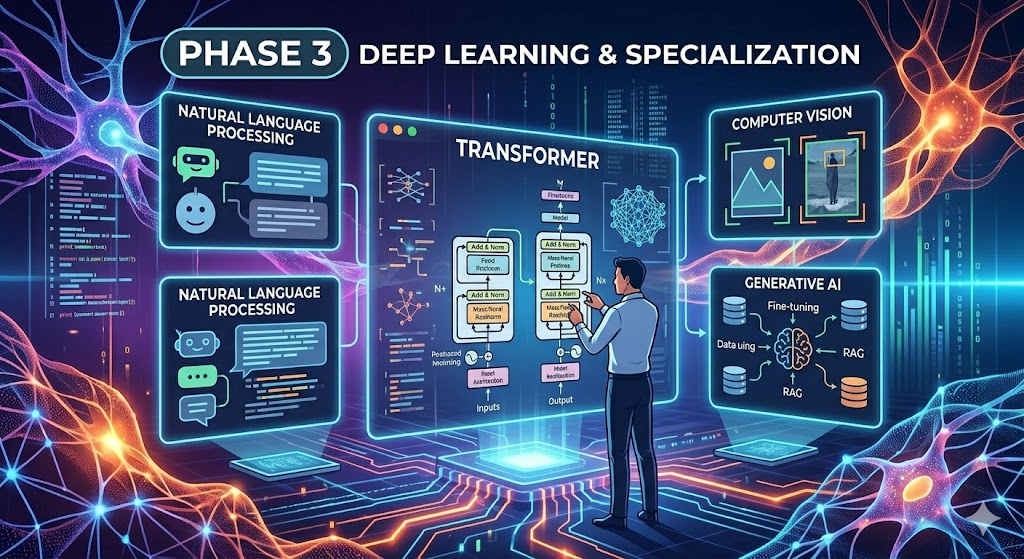
Goal: Differentiate yourself by developing expertise in a high-demand area.
Deep Learning fundamentals:
- Neural networks and backpropagation (understand the math, not just the API).
- Convolutional neural networks (CNNs) for image tasks.
- Recurrent neural networks (RNNs) and LSTMs for sequence data.
- Transformers: the architecture behind GPT, BERT, and every modern LLM.
- TensorFlow 2.0 or PyTorch (pick one and go deep).
Generative AI & LLMs: By 2026, understanding how large language models work and how to build applications on top of them will have shifted from a nice-to-have to a genuine differentiator on any data science resume. Learn:
- How fine-tuning works.
- Prompt engineering and retrieval-augmented generation (RAG).
- How to build a document-based chatbot using your company’s data.
Choose a specialization. Data science is broad, and narrowing your focus makes you both more hireable and more confident in interviews. Options:
- NLP / text analytics.
- Computer vision.
- Time series forecasting.
- AI in finance or healthcare.
- MLOps and model deployment.
Milestone: By the end of Phase 3, you should have a deep learning project in your portfolio and a clear specialization you can speak to confidently.
Phase 4 – Job-Ready Preparation (Months 9-12)
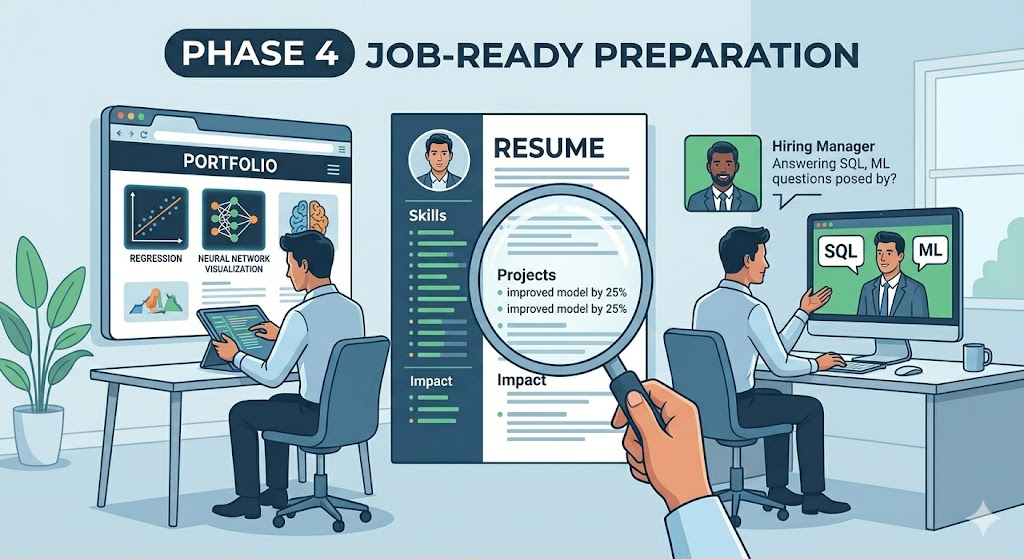
Goal: Convert your skills into a job offer.
Technical skills alone aren’t enough to land a job. This phase is about positioning yourself correctly in the market so that your skills actually get seen.
Build a strong portfolio. Your project portfolio should have:
- 3-5 well-documented projects with clear READMEs.
- At least one end-to-end project (data collection → model → deployment).
- Evidence of domain knowledge in your specialization.
Craft a data science resume. Common mistakes to avoid:
- Listing tools without context (don’t just say “Python, TensorFlow”; say what you built).
- Forgetting to quantify impact (e.g., “reduced model inference time by 40%”).
- Including irrelevant work experience without framing it through a data lens.
Interview preparation. Data science interviews typically have three components:
- Technical screen (SQL, Python, stats questions).
- ML concepts round (explain algorithms, evaluate model performance, discuss tradeoffs).
- Case study or take-home project (a real or simulated business problem).
Practice resources: open datasets and coding challenges for hands-on problem solving, CloudxLab’s guided projects for applied ML practice, and CloudxLab’s placement eligibility test for a structured mock assessment across all three interview components.
Network actively. Most jobs in India are still filled through referrals and community connections. Attend industry events, engage in data science forums and communities, and don’t underestimate the value of a well-crafted cold message to someone whose work you genuinely admire.
Realistic Timelines by Starting Point
| Starting Point | Time to Job-Ready |
| Complete beginner (no coding background) | 12-18 months |
| Engineer / IT professional with coding skills | 6-9 months |
| Graduate with a CS or statistics background | 4-6 months |
| Professional with domain expertise (finance, healthcare) | 6-9 months |
These aren’t guarantees; they’re realistic ranges for people who are learning consistently, building projects, and applying actively.
Should You Get a Certification?
This question comes up constantly, and the honest answer is: it depends on how you use it.
A certification from a recognised institution won’t get you a job on its own. But it does three important things:
- It signals commitment and structured learning to employers.
- It gives you a community of peers and mentors.
- It forces you to complete a curriculum rather than bouncing between free resources indefinitely.
Programs that carry real weight in India’s hiring market tend to come from institutions with established credibility and a curriculum that includes hands-on lab work, not just video lectures. A certificate that requires you to build and submit real projects is worth significantly more than one you earn by watching videos.
CloudxLab’s Post Graduate Certificate Program in AI and Machine Learning, offered in partnership with IIT Roorkee, is one example of a program that checks these boxes: IIT brand credibility, 24/7 cloud lab access, auto-assessed projects, and over 57,000 enrolled learners who’ve gone through the same journey.
But whatever program you choose, make sure it forces you to do the work, not just watch it being done.
Common Mistakes People Make on This Journey
Mistake 1: Tutorial hell. Watching course after course without building anything original. After Phase 1, you must build.
Mistake 2: Skipping the math. You don’t need a PhD in statistics, but you do need to understand why a model behaves the way it does. Blindly applying scikit-learn without understanding the underlying algorithm makes you vulnerable in interviews.
Mistake 3: Waiting until you feel ready to apply. You’ll never feel fully ready. Apply when you have 2-3 solid projects and can hold a coherent technical conversation. The feedback from real interviews is more valuable than another month of studying.
Mistake 4: Ignoring communication skills. A model that no one understands or trusts doesn’t get used. Practice explaining your work in plain language regularly.
Your First 30 Days: A Concrete Action Plan
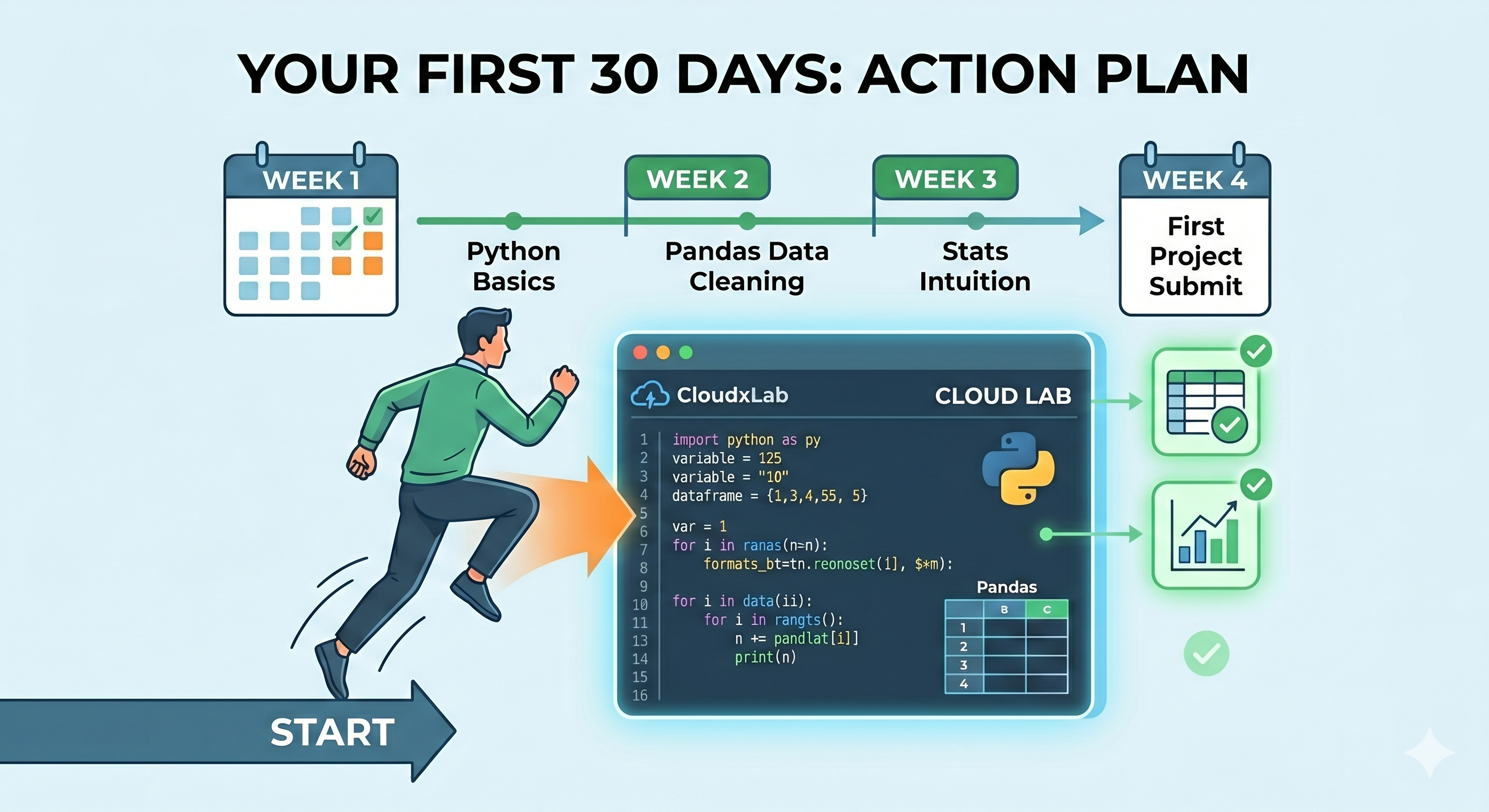
If you’re starting today, here’s exactly what to do in your first month:
- Week 1: Jump straight into CloudxLab’s cloud lab, no local setup needed. Complete Python basics covering variables, lists, dictionaries, loops, and functions.
- Week 2: Start Pandas. Load a real dataset from CloudxLab’s project library, explore it, clean it, and answer three business questions with code.
- Week 3: Learn basic statistics, focus on the intuition behind each concept, then write Python code that demonstrates it so the theory becomes muscle memory.
- Week 4: Build your first mini-project end to end. Pick something simple, a movie recommendation or a sales analysis document it properly, and submit it through CloudxLab’s auto-assessment engine for instant feedback.
One month from now, you’ll have more momentum than most people who’ve been “thinking about data science” for a year.
Final Thoughts
Becoming a data scientist is challenging, but it’s one of the most structured and learnable career transitions available to anyone willing to show up consistently.
The roadmap is clear, the tools are accessible, and the demand is real. What remains unpredictable is whether you’ll build the habit of showing up daily, push through the frustration of bugs and failed models, and actually submit that application when you feel only 70% ready.
That 70% is enough. Get started.
Ready to start your data science journey?
CloudxLab offers a hands-on, cloud-based learning environment where you can write real code from day one, with no setup, no friction, just learning. Explore our Post Graduate Certificate in AI and Machine Learning with IIT Roorkee or try the lab free for a week.