

The Job That Barely Existed Two Years Ago
Two years ago, if you had written “Agentic AI Engineer” on your resume, most hiring managers would have looked at you blankly.
Today, that same title is appearing in job postings from Bangalore to Berlin. Companies are advertising for it urgently, offering salaries that reflect genuine scarcity, and in many cases, not finding the people they need.
This is not a gradual skills gap. It is a sharp, sudden chasm between what the industry needs and what the talent pool can currently supply. And it opened so fast that even many experienced ML engineers are not yet on the right side of it.
It is really important for people who want to work with AI to learn these skills and understand why there is such a high demand for them.
This post is that understanding, written in full.

What Agentic AI Actually Means Precisely
Before we talk about skills and careers, we need to be precise about what “agentic AI” actually means. The term is used loosely in marketing, loosely in the press, and loosely in job postings. Precision matters here.
An AI agent is an AI system that can take actions in the world to accomplish a goal, not just produce text in response to a prompt.
Typical LLM interactions involve a single prompt and response, lacking external actions, persistence, or the capacity to influence anything beyond the dialogue.
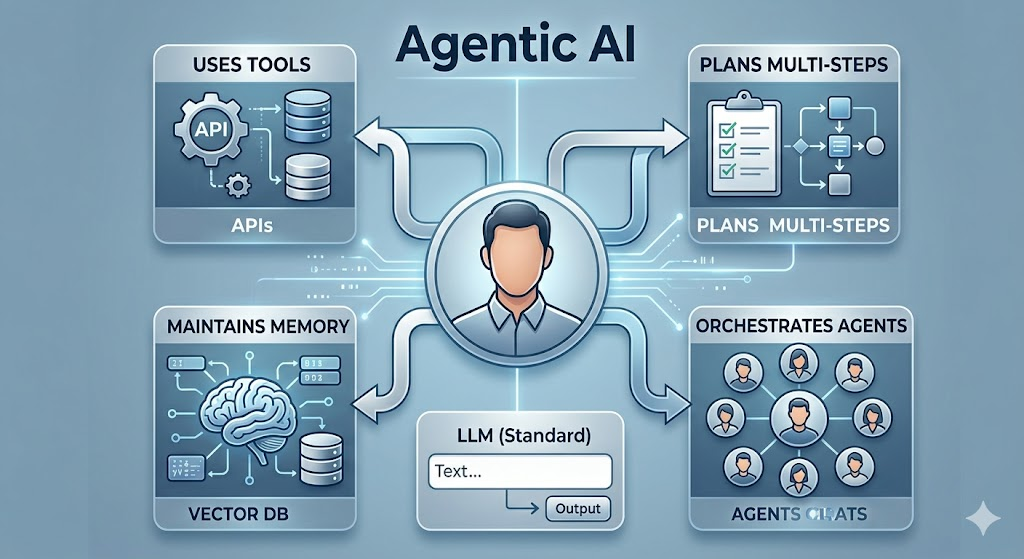
An agentic AI system is different along several critical dimensions:
It can use tools. An AI agent can call external APIs, search the web, query a database, run code, read and write files, send messages, and interact with software systems. AI agents transcend text generation by executing real-world actions that alter the environment.
It can plan across multiple steps. Given a high-level goal, an agent can break it down into a sequence of sub-tasks, execute them in order (or in parallel), evaluate whether each step succeeded, and adjust its approach based on results. This is fundamentally different from single-turn generation.
It can maintain memory. An agent can remember context from earlier in a conversation, store information in external memory systems, and retrieve relevant past context when needed. It is not starting from zero every interaction.
It can orchestrate other agents. In multi-agent systems, which are increasingly the architecture of choice for complex tasks, individual agents specialise in specific capabilities, and an orchestrator agent coordinates their work toward a shared goal.
Put these capabilities together, and you have a system that can do meaningful, multi-step, real-world work with varying degrees of autonomy. That is a genuinely new category of software capability, and building it requires a genuinely new set of skills that most ML engineers and software developers do not currently have.
Why the Skills Gap Is So Sharp Right Now
The scarcity of agentic AI engineers is not because the field is impossibly hard. It is because of timing and because the required skill set sits at an unusual intersection.
The Timing Problem
Agentic AI as a practically buildable paradigm is very recent. The LLM capabilities required to make agents work reliably enough to be useful became available roughly eighteen to twenty-four months ago. The tooling ecosystem LangChain, LlamaIndex, AutoGen, CrewAI, and others matured rapidly over the past year. The architectural patterns solidified even more recently.
This means that even experienced ML engineers who have been in the field for five years have had at most eighteen months to develop agentic AI skills, and most have been occupied with other priorities. The field moved faster than the upskilling pipeline.
The Unusual Intersection Problem
Agentic AI engineering requires skills from multiple domains that have historically been taught and practised separately:
- ML engineering: Understanding of LLMs, fine-tuning, evaluation, and model behaviour.
- Software engineering: Building reliable, observable systems with proper error handling, state management, and testing.
- Prompt engineering: Designing instructions that reliably guide model behaviour across diverse inputs.
- Systems architecture: Designing multi-component systems where agents, tools, memory, and orchestration interact correctly.
- Evaluation and monitoring: Assessing whether agents are performing as intended and detecting failures in production.
Very few people have all of these. A strong ML engineer may lack systems architecture experience. A strong ML engineer may lack systems architecture, a strong software engineer may lack LLM intuition, and a strong prompt engineer may lack both. The combination is rare, and rarity commands a premium.
The Demand Side is Exploding
Every serious technology company, and an increasing number of non-tech enterprises, is now attempting to build agentic AI capabilities into their products and operations. The demand for people who can build these systems is growing faster than the supply is responding.
In India specifically, the combination of a large and technically skilled developer population and a rapidly expanding AI adoption curve means the opportunity for well-positioned candidates is significant. The question is positioning.
The Specific Skills That Agentic AI Engineering Requires
Let’s be concrete. Here are the specific skills that agentic AI engineering requires, in order of foundational importance.
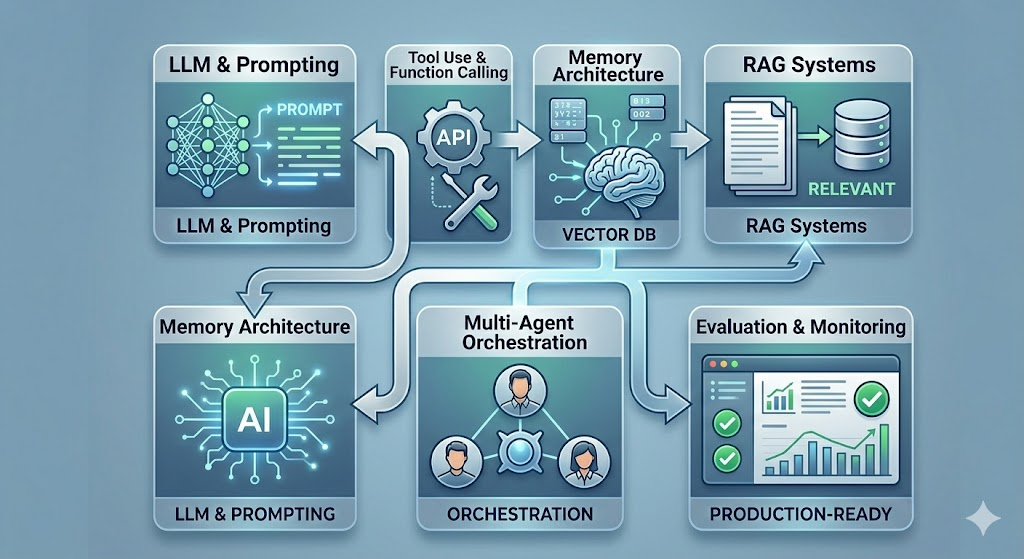
1. A Solid Foundation in LLMs and Prompting
Before you can build agents, you need to understand the capabilities and limitations of large language models, not at a surface level, but with enough depth to make good architectural decisions.
This means understanding: how transformer-based models work conceptually, what a context window is and how to manage it, why models hallucinate and how to mitigate it, how temperature and sampling parameters affect output, and how to write prompts that produce reliable, predictable behaviour across diverse inputs.
Prompt engineering is not a trivial skill. It is the primary interface between the developer’s intention and the model’s behaviour. In agentic systems, where the model is making decisions and taking actions, poorly designed prompts lead to unreliable agents that behave unexpectedly in production.
2. Tool Use and Function Calling
The mechanism by which agents interact with the external world is called function calling or tool use. The LLM is given a set of available tools with descriptions of what each tool does and what parameters it takes, and it decides when to call which tool based on the current state of the task.
Building robust tool use requires: designing clear, unambiguous tool descriptions that the model can reason about correctly, handling tool outputs, including errors and unexpected responses gracefully, and managing the interaction between tool results and the model’s ongoing reasoning.
This is a practical, hands-on skill. You learn it by building systems where tools fail unexpectedly and figuring out how to make them resilient.
3. Memory Architecture
Different tasks require different kinds of memory:
In-context memory is simply what fits in the model’s context window: the conversation history, the current task state, and recent tool results.
External memory uses vector databases (like Pinecone, Weaviate, or Chroma) to store and retrieve information that doesn’t fit in context. When an agent needs to “remember” something from a long time ago, or needs to search through a large knowledge base, it queries the vector database for the most relevant information and loads that into context.
Episodic memory stores summaries of past interactions so that an agent can maintain a persistent understanding of a user’s preferences, history, and context across sessions.
Designing the right memory architecture for a specific use case, knowing when to use in-context memory, when to use vector retrieval, and how to manage the tradeoffs, is a non-trivial skill that comes from building real systems.
4. Retrieval-Augmented Generation (RAG)
RAG is the technique of connecting a language model to an external knowledge base of your company’s documentation, a database of research papers, or a product catalogue, so that the model’s responses are grounded in accurate, specific, up-to-date information rather than purely in its training data.
Building a good RAG system is harder than it sounds. The quality of retrieval determines the quality of generation. Getting the chunking strategy right, choosing the right embedding model, designing queries that retrieve the most relevant context, and handling cases where the retrieved context is incomplete or contradictory are the practical challenges that take a RAG system from proof-of-concept to production reliability.
RAG is now a foundational skill for almost all agentic AI work. It is how agents access domain-specific knowledge. It is one of the most commonly required skills in agentic AI job postings.
5. Agent Orchestration and Multi-Agent Architecture
As tasks become more complex, single-agent architectures hit their limits. Multi-agent systems where specialised agents handle specific parts of a workflow and an orchestrator coordinates them are increasingly the architecture of choice for serious agentic applications.
Building multi-agent systems requires: designing clear agent roles and boundaries, managing communication between agents, handling failures in one agent without cascading to the entire system, and evaluating the performance of a system where multiple components interact in complex ways.
Frameworks like LangGraph, AutoGen, and CrewAI provide scaffolding for multi-agent systems, but understanding the underlying architecture, why the system is designed the way it is, what can go wrong, and how to debug it when it does requires genuine depth.
6. Evaluation and Monitoring in Production
This is the most underappreciated skill in the entire agentic AI stack, and it is the one that separates engineers who can build agents that work in demos from engineers who can build agents that work in production.
Agents are hard to evaluate because their outputs are often long-form, multi-step, and context-dependent. There is no single metric that captures whether an agent is performing well. Building evaluation frameworks requires: defining what “good” looks like for the specific task, designing test cases that cover the range of inputs the agent will encounter, implementing automated checks where possible, and building monitoring systems that detect failures in production before they cause serious problems.
Companies that are hiring agentic AI engineers are not just looking for people who can build agents. They are looking for people who can build agents that work reliably and can be monitored, debugged, and improved over time. Evaluation and monitoring are what make that possible.
What the Learning Path Looks Like
Building these skills from scratch is a structured process. Here is the realistic path, in sequence.
Foundation: LLMs and the Agentic Paradigm (Weeks 1–4)
Before building anything, develop a clear conceptual understanding of how LLMs work, what their capabilities and limitations are, and what the agentic paradigm means architecturally. Work through prompt engineering fundamentals, zero-shot, few-shot, and chain-of-thought prompting. Build your first simple tool-calling interaction manually, without a framework, so you understand what is happening beneath the abstraction.
Core Skills: RAG and Tool Use (Weeks 5–10)
Build your first RAG system from scratch: ingest a real document set, create embeddings, store in a vector database, implement retrieval, and connect to an LLM for generation. Measure the quality of retrieval. Experiment with different chunking strategies and see how they affect output quality.
Separately, build an agent that uses real external tools: web search, a calculator, a database query. Focus on making the tool use robust: what happens when the tool returns an error? What happens when the model calls the wrong tool? Build your intuition for failure modes.
Intermediate: Agent Frameworks and Memory (Weeks 11–18)
Now work with agent frameworks, such as LangChain, LangGraph, or similar, with a clear understanding of what they’re doing under the hood. Build agents with persistent memory, including in-context and external vector memory, to create conversational agents that recall user preferences across sessions.
Build a multi-step research agent: give it a question, have it search the web, synthesize information, identify gaps, search again, and produce a structured report. This kind of multi-step, tool-using, memory-maintaining agent is close to what many real production use cases require.
Advanced: Multi-Agent Systems and Production Evaluation (Weeks 19–26)
Build your first multi-agent system: a workflow with at least three specialised agents and an orchestrator. Focus on failure handling: what happens when one agent fails or produces bad output? How does the orchestrator detect and respond to this?
Build an evaluation framework for one of your agents: define what good performance looks like, write test cases, implement automated checks, and build a monitoring dashboard. This is the work that transitions you from “can build agents” to “can build production-grade agents.”
The Gap Nobody Talks About: Why Agent Projects Fail in Production
There is a version of the agentic AI skills conversation that stops at “learn LangChain, and you’re employable.” This version is incomplete and, for anyone who ends up taking a job building production AI agents, potentially career-damaging.
The gap that most agent projects hit is not in the building, but in the reliability.
Agents that work beautifully in a controlled demo environment, on a specific set of test inputs, with a predictable user, frequently fall apart when exposed to the variability of real production use. Users phrase things unexpectedly. Tools return errors. The model makes a wrong decision at step 3, and everything downstream is corrupted. Context windows fill up, and important information gets dropped.
The genuinely valuable engineers, the ones companies compete for, are not just the ones who can set up a LangChain pipeline. They are the ones who can look at a failing agent, diagnose exactly what went wrong and why, and fix it in a way that makes the system more robust going forward. They are the ones who designed the evaluation framework that caught the failure before it affected users.
This diagnostic skill, this deep intuition for how agents fail and how to make them more reliable, is built through practice on real problems in real environments. It cannot be built by just reading documentation or watching tutorials. Instead, it’s built by building, breaking, and understanding why.
This is why CloudxLab’s agentic AI curriculum is built around the cloud lab environment rather than around lectures. The lectures provide the concepts. The lab is where the real learning happens: the debugging, the iteration, the failure analysis, the gradual development of the intuition that makes someone genuinely good at this.

What the Job Market Is Paying For These Skills
Let’s be direct about career economics, because they are genuinely compelling.
Agentic AI engineering roles in India are commanding salaries significantly above the market rate for general software development and even above many traditional ML engineering roles. In 2026, mid-level agentic AI engineers at product companies in Bengaluru, Hyderabad, and Mumbai are seeing compensation packages that reflect the genuine scarcity of the skill set.
Beyond salary, the career trajectory is strong. Agentic AI is not a narrow specialization; it is a skill set that opens doors across industries. Healthcare companies building clinical decision support agents, fintech companies building compliance and fraud detection agents, and edtech companies building personalized learning agents. The applications are broad, and the demand is spread across sectors.
For learners currently in traditional software engineering, data analysis, or even earlier stages of their ML career, developing genuine agentic AI competence in 2026 is one of the highest-leverage career investments available.

The Honest Prerequisites
Before you invest seriously in agentic AI, be honest with yourself about whether you have the foundations in place.
You need: working Python proficiency, basic understanding of how APIs work and how to call them, familiarity with the concept of machine learning and what LLMs are, and comfort with reading documentation and debugging code independently.
You do not need: a deep mathematical background in ML, experience with training models from scratch, or prior experience with neural networks. Agentic AI engineering is closer to software engineering than to research ML. The mathematical depth required is lower than many people assume.
If you have those foundations, you are ready to start. If you don’t, CloudxLab’s foundational programmes in Python and machine learning will build them, and the agentic AI curriculum will be waiting on the other side.
A Field That Is Still Being Defined
One more thing worth saying about agentic AI as a career choice: you are entering a field that is still being defined.
The architectural patterns are still solidifying. The evaluation methodologies are still being developed. The best practices for production deployment are still being discovered. The frameworks are still evolving rapidly.
This is uncomfortable for people who prefer to learn from settled, authoritative sources. But for people who are energised by working at the frontier by being part of a community that is figuring things out in real time, it is an extraordinary moment to be building these skills.
The people who develop genuine agentic AI competence over the next twelve to eighteen months will not just be following the field as it matures. They will be shaping it.
That is a rare opportunity. It does not stay available for long.
Build Agentic AI Skills With CloudxLab
CloudxLab‘s Machine Learning, Generative AI & Agentic AI Specialization is designed to take you from ML foundations all the way through building, evaluating, and deploying production-grade agentic AI systems in a hands-on cloud lab environment where you build real things, not just watch someone else build them.
The program is designed for all students, working professionals or people switching career: self-paced, lab-based, with mentorship access and a credential supported by CloudxLab’s partnership with EICT IIT Roorkee.
If you are serious about being on the right side of the agentic AI skills gap, not watching it from the outside, this is where to start.